
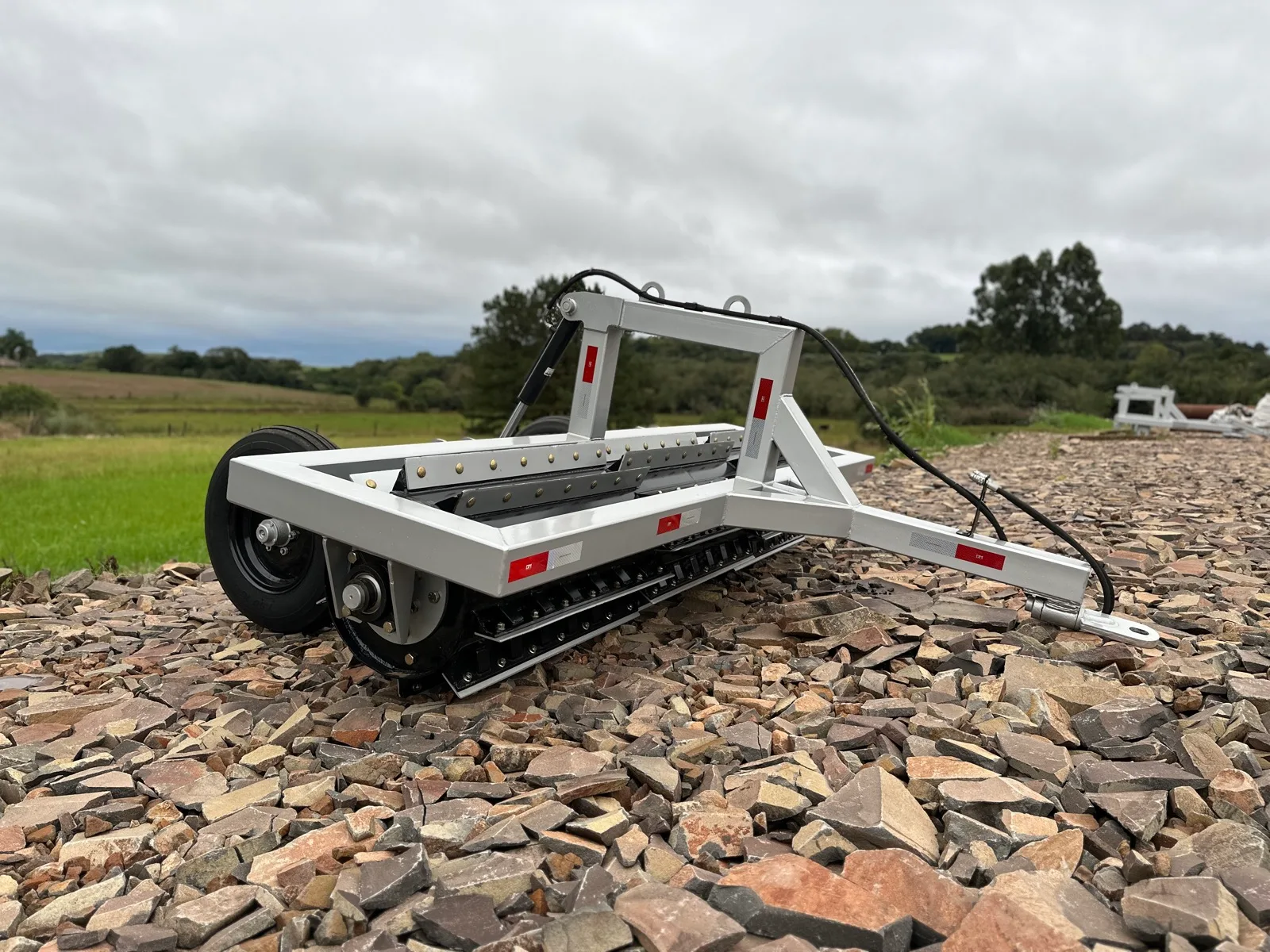
A 1.5-metre knife roller is not exclusive to coffee. This working width can suit cover crop management between citrus trees, grapevines and other orchard crops where the alley accommodates both tractor and implement.
The common application is working on inter-row vegetation while keeping biomass on the surface. Roller width defines the managed strip; the crop, cover and timing determine how to use it.
Coffee: managing cover between rows
Between coffee trees, cover crops need to be managed according to the development of both the coffee crop and the vegetation. The knife roller works on the cover, not the coffee trees.
Embrapa’s publication on soil and water management and conservation in the context of environmental change presents knife rolling as an option for managing annual green manures in coffee at full flowering. This guidance applies to the species and system described, not every type of vegetation in a coffee plantation.
Citrus: cover between orange, lemon and mandarin trees
In citrus orchards, a knife roller can flatten inter-row vegetation and form a cover over the soil.
Embrapa’s publication on organic citrus production in Rio Grande do Sul documents this practice and distinguishes plants that respond better to rolling from those that are harder to control. Species and growth stage matter: managing cover does not mean eliminating every volunteer plant.
Management of the strip near trunks and vegetation beneath the canopy is also part of orchard management.
Vineyards: rolling inter-row cover
In vineyards, a knife roller can manage cover in the alleys between rows while avoiding vines and trellis structures.
A Cornell case study published in 2024 reports the use of a five-foot roller-crimper — approximately 1.52 m — in a Concord grape vineyard in the United States. It is a documented example of work within this width range, not a trial of the Ventania 1.500.
The case demonstrates a possible application, not an identical outcome for every vineyard.
Other orchards and strips of cover
The same inter-row approach can be considered in other orchards: work the strip of vegetation that suits the implement without contacting the main crop.
Knowing the distance between row centres is not enough. Canopies, branches, posts, irrigation and turning space determine the actual available corridor.
What about solar panels?
Alleys between rows of solar panels are a possible application to assess, not a use proven by the agricultural references in this article.
Feasibility depends on vegetation, clearance for the tractor and implement, and the installation’s maintenance rules. The site manager must consider structures, cables and access. A working width of 1.5 m alone does not authorise operation beneath modules or replace the solar farm’s maintenance plan.
Ventania 1.500: one working width, different applications
The Industrial Triângulo Ventania 1.500 offers 1.5 m working width. Its applications go beyond coffee to cover management between rows and in narrow strips.
The references in this article support uses of knife rollers; they do not prove yield or model-specific performance in each crop.
Frequently asked questions
Is a 1.5 m knife roller only for coffee?
No. Coffee, citrus and vineyards have documented inter-row uses of knife rollers or roller-crimpers. Width selection depends on clearance and the management planned for the area.
Does a knife roller replace a mower in every situation?
Not necessarily. Response to rolling varies with species and growth stage. The aim may be to flatten and manage cover without eliminating all vegetation.
Is a 1.5 m alley enough for the tractor and implement?
Working width is not the total clearance needed for operation. The tractor, implement, surrounding plants and structures must all be considered.
Can I combine cover management with small-seed distribution?
With a compatible option, both tasks can be performed in the same pass. See knife roller and small seeds: two tasks in one pass.